Request A Quote
 Contact Us
 UK (Select Country)

 India
 Australia
 USA
 South Africa
 Malaysia
 German
 UAE



BioMix Pumps
Efficient for mix and transfer solid bio waste and digestate liquid into the fermentation tank
Flow Rate -
Up to 295 m3/hr / 1300 GPM
Pressure -
Up to 12 Bar / 175 PSI


What Are Bio Mix Pumps ?
A BioMix pump is a specialized pumping system used in biogas plants to mix and transfer organic waste, bio waste, and digestate into anaerobic fermentation tanks. It combines a mechanical feed screw and a progressive cavity pumping mechanism, enabling efficient handling of high-solid, fibrous, and heterogeneous organic materials.These pumps are widely used as pumps for biogas plants and solid bio-waste transfer pumps, where conventional pumps struggle with thick or non-flowing substrates.


How BioMix Pumps Work (Working Principle)-
BioMix pumps use a combined mechanical feeding and progressive cavity pumping process.
The process can be understood in the following stages:
Digestate Slurry Mixing
Inside the hopper, a rotating auger screw mixes the incoming biomass. This process:- Breaks down large chunks
- Blends dry and wet components
- Prevents bridging of materials
The result is a more uniform mixture.
Bio Waste Loading
Organic waste or bio waste is loaded into a large feed hopper. The wide hopper design allows bulky or fibrous materials such as silage or agricultural residue to enter easily.
Controlled Feeding to the Pump
The auger pushes the homogenized biomass toward the pump inlet at a controlled rate. This ensures that the pumping section receives a steady and consistent feed.
Transfer To Fermentation Tank
The mixed substrate is delivered into the biogas fermentation tank, where microbial digestion begins and biogas is produced.
Progressive Cavity Pumping
The progressive cavity pump then moves the material forward using a rotor-stator mechanism:- A single helical rotor rotates inside an elastomer stator
- Sealed cavities form between them
- These cavities move the material from suction to discharge
This action enables smooth and continuous transfer of high-viscosity bio waste.
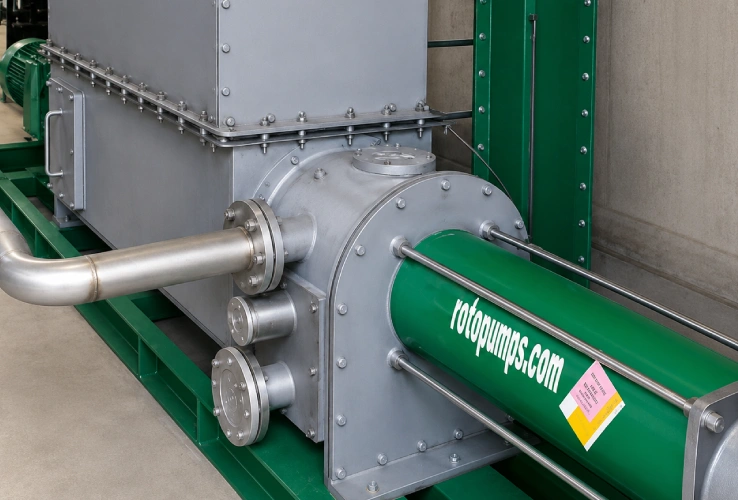
Roto BioMix Pumps Used in Biogas Plants
Supporting Sustainable Waste Management Worldwide
Biogas is emerging as a vital renewable energy solution in the global transition toward cleaner and more sustainable power sources. Produced through the anaerobic digestion of organic materials such as agricultural residues, food waste, and animal manure, biogas converts waste into valuable energy while reducing environmental impact. Unlike fossil fuels, biogas is renewable, locally available, and helps significantly lower greenhouse gas emissions. It also supports circular economy principles by turning organic waste into energy and nutrient-rich digestate that can be reused as biofertilizer.
As industries and communities look for sustainable alternatives, the adoption of biogas systems is becoming increasingly important.
Biogas plants not only generate renewable energy but also improve waste management, reduce landfill dependence, and support energy independence in rural and industrial regions. With growing concerns about climate change, energy security, and resource efficiency, investing in biogas infrastructure offers a practical path toward a greener energy future. Moving toward biogas solutions enables organizations to reduce their carbon footprint while transforming organic waste streams into reliable, clean energy.
Biogas production relies on the controlled digestion of organic materials such as agricultural residues, manure, grass corn silage, municipal waste, waste fodder, fish and slaughterhouse waste, sugar waste and most importantly food waste etc. These materials typically have high viscosity, irregular particle sizes, and significant solid content.
Traditional pumping systems often face problems such as:
- Material bridging or clogging
- Inconsistent feeding into digesters
- Excessive wear from abrasive solids
- Poor mixing of dry and wet biowaste
BioMix pumps address these issues by performing mixing and pumping within the same unit, allowing consistent feeding of substrate into the digester.

Key Advantages
- Large Auger - Feed Screw Designed for crushing and mixing of dry wet media and feeding of the substrate. Options available in plasma nitride coating.
- Rectangular Hopper Hopper options available with additional large inlet flange for substrate mixing.
- Round Hopper Designed to handle a high degree of solid content.
- Inspection Cover For easy access, quick inspection, and maintenance.
- Stone Catcher Designed to trap large solid particles inside the hopper.
- Heavy Duty Bearing Housing Capable of taking high axial thrust and can be directly coupled with a geared motor.
- Inbuilt Feed Flange Left-handed & right-handed ports are included as standard for feeding digestate to ensure optimum homogenization.
- Thrust Bush Joint & Cardan Universal Joint Universal joint with sleeve protector & flight wing to avoid any solid build-up.
Key Benefits of Design
BioMix pumps provide several operational advantages in biomass processing and biogas generation.
Efficient Handling of Solid Biowaste
Capable of transferring high-solid organic waste and fibrous materials without clogging.
Integrated Mixing Function
Combines mixing, crushing, and pumping, eliminating the need for separate mixing equipment.
Stable Flow Characteristics
Positive displacement pumping ensures uniform flow rates even when system pressure changes.
Reduced Risk of Blockages
The feed screw mechanism minimizes accumulation of fibrous materials.
Improved Fermentation Efficiency
Better substrate homogenization leads to more effective anaerobic digestion.
Lower Mechanical Stress
Slow operating speeds reduce wear on pump components.
Pump Selection Guide
How to Select the Right BioMix Pump
Selecting the correct pump for biogas plants requires careful evaluation of process conditions.
Bio Waste Composition
Identify the type of substrate being handled:
- Animal manure
- Agricultural residue
- Waste fodder
- Food waste
- Energy crops
- Digestrate
- Grass Corn silage
- Municipal biological waste
- Cereal Sheds
- Pomace
- Sugar Beet
Solid Content
Determine the percentage of dry solids present in the biomass mixture.
Required Flow Rate
The pump must match the feeding capacity required for the fermentation system.
Discharge Pressure
Pipeline length, elevation, and digester pressure influence pump selection.
Maintenance Accessibility
Choose pumps designed for easy inspection and service to minimize downtime.
Material Durability
Abrasive biomass may require wear-resistant coatings or hardened components.
Particle Size
Large or fibrous particles require larger hopper openings and stronger auger systems.
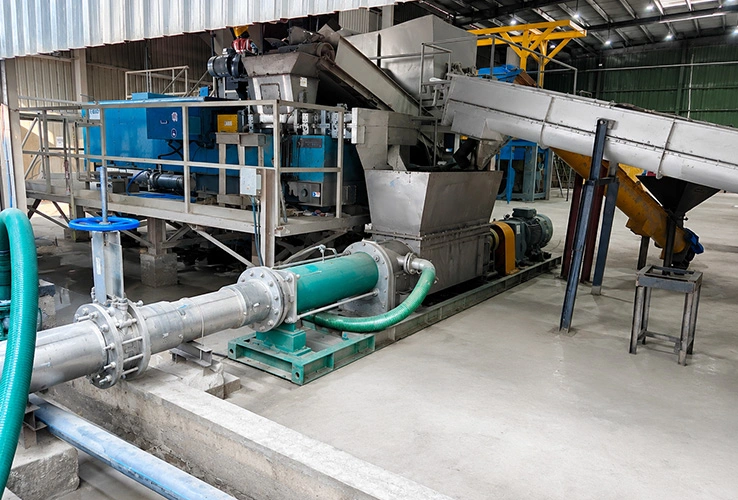
Advantages of BioMix Pumps in Biogas Fermentation
Using dedicated pumps in biogas fermentation improves process stability and efficiency.
- Ensures consistent biowaste feeding to digesters
- Improves mixing of dry and liquid substrates
- Reduces the risk of pump clogging
- Enhances microbial digestion efficiency
- Supports continuous plant operation
These factors ultimately contribute to more stable and efficient biogas production.
Want To Customize Your BioMix Pumps?
Talk To OUr Pump expertsNeed Help Selecting a BioMix Pump?
Choosing the right BioMix pump for a biogas plant or biomass transfer system requires careful analysis of material characteristics, solids content, and flow requirements. Consult an experienced industrial pump manufacturer or supplier to determine the best pump configuration for your biogas processing system.
Roto Progressive Cavity Pump Range